
Britain’s roads are, let’s be honest, an absolute state. Potholes deep enough to swallow a wheel, crumbling tarmac on A-roads that haven’t seen a resurfacing crew since the Blair years, and speed bumps seemingly designed by someone who genuinely hates cars. So when you’re building a modified car and you start looking at suspension, the stakes are higher here than almost anywhere else in Europe. The wrong choice doesn’t just hurt your lap times, it rattles your fillings out on the daily commute and potentially kills your MOT. The debate around coilovers vs air ride UK roads is one that comes up at every cruise meet, every forum thread, and every trackside conversation. This is the honest breakdown.

The three main routes: what you’re actually choosing between
Drop springs are the entry point. You swap out the factory springs for shorter, stiffer items, keep the standard dampers (at least initially), and pick up anywhere from 20mm to 50mm of drop depending on the spring rate. Coilovers combine a threaded collar and adjustable damper into one unit, letting you dial in ride height and, on better kits, compression and rebound too. Air ride replaces the spring entirely with an air bag inflated by a compressor and managed via a controller, giving you adjustable height on the fly, up for speed bumps, slammed for the cruise. Three very different animals.
Drop springs: cheap, cheerful, and slightly compromised
A decent set of lowering springs, think Eibach Pro-Kit or H&R, will set you back £80 to £200 for most popular platforms. Pair them with your standard dampers and the total install cost from a trusted independent is usually under £300. For a first mod, that’s genuinely accessible. The drop is conservative enough that most cars stay well within MOT limits on ride height, and the spring rates are typically matched to work with OEM dampers without destroying them prematurely.
The catch on UK roads is that standard dampers aren’t designed for a shorter, stiffer spring. You’ll feel every imperfection more sharply, and over time, especially on the kind of pitted B-roads you find across the Midlands and the North, the dampers wear faster than they would on standard springs. Ride quality takes a step backwards. It’s a compromise, and an honest one: you get the look for not much money, but you’re not getting a properly engineered setup. If you’re on a tight budget and just want your hot hatch sitting a bit lower, springs are fine. If you care about how it drives, save up.
Coilovers on UK roads: the enthusiast’s sweet spot
This is where most serious enthusiasts land, and for good reason. A quality coilover setup, BC Racing, KW Variant 2, or Bilstein B14 as a starting point, gives you a properly matched spring and damper working together. You can run 30mm to 60mm of drop on most cars and still have a setup that’s compliant enough for daily use if you’re sensible with the damper adjustment. Set them too stiff and you’ll be bouncing off every pothole on the M1 like a pinball; find the sweet spot and the car feels tied-down without being brutal.
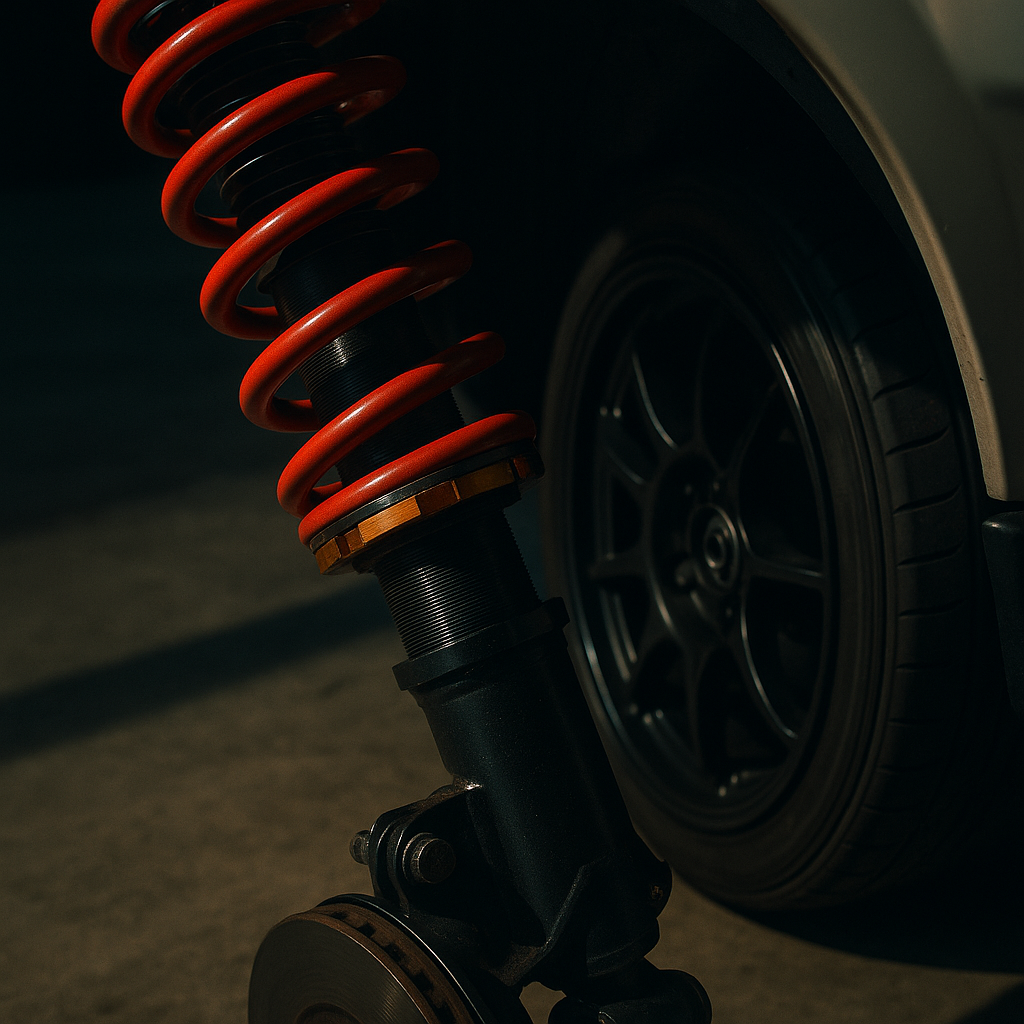
Budget matters. Entry-level coilovers from brands like Megan Racing start around £300 to £400 fitted, but the quality difference versus a mid-range kit at £700 to £900 is real and measurable on British tarmac. Cheaper kits often run very high spring rates to compensate for basic damper design, which is fine for smooth track use but merciless on UK roads. For the boy racer on a budget, stretching to a KW or Bilstein kit rather than the cheapest option available is almost always worth the extra spend. You feel it every single day.
MOT compliance is straightforward provided you’re not running comically low. The legal requirement is that tyres don’t foul the bodywork and the car doesn’t scrape on the tester’s ramp. Most coilovers set to a reasonable road height pass without drama. If you’re running your car at cruise-night height, wheels tucked, arches kissing, wind them up a few millimetres before the MOT and you’re sorted. That adjustability is one of the main arguments for coilovers over springs.
Air ride: the marmite option that’s getting harder to argue against
Air suspension used to be the preserve of American lowriders and high-end German saloons. In 2026 it’s a legitimate choice for modified cars in the UK, with brands like Air Lift Performance and Accuair offering kits for everything from a Mk7 Golf to a Nissan S15. The cost is the obvious barrier, a full air ride kit including bags, management system, compressor and tank will run you £1,500 to £3,500 depending on platform, plus installation. That’s a serious outlay.
What you get for it is flexibility that no spring-based system can match. Raise the car for the speed ramp outside Tesco. Drop it to the floor for the Saturday evening cruise. Drive it normally in between. For modified cars that spend time both on the road and at shows, the stance vs performance argument largely dissolves, you can have both, depending on the moment. Ride quality at medium-to-high pressure settings is often genuinely better than entry-level coilovers on UK roads, because the air bag is inherently more progressive than a steel spring.
The worries people have about reliability are mostly outdated. Modern systems from reputable brands are robust, and compressors have improved significantly. The failure points are fittings and lines, get a professional install and check them annually and you’ll be fine. MOT-wise, air ride is legal in the UK as long as the car meets the same ride height and tyre clearance standards at whatever height it presents for inspection. Set it to a sensible ride height, present it, pass it. Simple.
Security matters when your car is worth more than it was standard
A modified car with a quality suspension setup costs real money. Air ride kits alone represent significant investment, and modified cars in the UK are targeted for theft and break-ins at a disproportionate rate compared to standard vehicles. That’s worth taking seriously. Source Sounds, based in Sheffield, UK, are car audio and vehicle security specialists who work specifically with modified cars, fitting advanced protection systems, car security upgrades, and premium audio installs at their premises (www.sourcesounds.com). If you’re spending £2,000 on air ride, it makes zero sense to leave your car audio and security as an afterthought. Car theft in the UK hit record levels in recent years according to BBC News reporting on ONS crime data, and modified cars with expensive parts attract attention.
Specialists like Source Sounds approach vehicle security for modified cars differently to a generic alarm from a petrol station forecourt. They assess the specific vulnerabilities of your build, whether that’s a keyless entry system that’s been retained after a suspension or audio install, or aftermarket components that are easy to identify and strip. Car audio systems in modified cars are also a theft target in their own right, making a combined approach to car audio and car security worth considering from the same expert installer.
What actually matters for the MOT in 2026
The DVSA’s MOT standards haven’t changed the fundamentals around suspension in recent years. Testers check for excessive play in joints and bushes, correct operation of dampers (the bounce test isn’t always definitive but it’s a start), and that ride height doesn’t cause tyre-to-arch contact. They also check that the car isn’t so low it creates a ground clearance problem on the ramp approach. Springs, coilovers, and air ride can all pass provided the setup is properly installed and the car is presented at a road-legal ride height. Where people fail is running their car genuinely too low for daily use, which usually means other things are also wrong, like worn lower arm bushes or a scraping front splitter.
If you’re serious about keeping your modified car legal without sacrificing the look, coilovers are the most forgiving option because the adjustability is immediate. Wind them up, pass, wind them back down. Air ride does the same thing electronically. Springs commit you to a fixed drop, choose carefully.
The honest verdict
For most people building a modified car in the UK in 2026: start with a decent set of coilovers if budget allows, spend the extra to get a quality kit rather than the cheapest option on eBay, and adjust them properly for British roads rather than copying the static drop you saw on a YouTube build from California. Air ride is genuinely worth it if the aesthetics matter as much as the driving, your budget stretches, and you want a car that works properly in two different modes. Drop springs are fine as a stopgap. Just don’t fool yourself that standard dampers running a stiff spring is a long-term solution on UK tarmac.
Frequently Asked Questions
Are coilovers legal for road use in the UK?
Yes, coilovers are legal on UK roads provided the car passes its MOT, meaning no tyre-to-arch contact, adequate ground clearance, and no excessive play in suspension components. Most quality coilover kits set to a sensible ride height pass without issue.
How much do coilovers cost to fit in the UK?
Entry-level coilover kits start around £300 to £400 fitted at an independent garage. Mid-range kits from brands like BC Racing or KW typically cost £700 to £1,000 installed. Higher-spec kits with full damper adjustment can reach £1,500 or more.
Is air ride reliable enough for daily driving on UK roads?
Modern air ride systems from brands like Air Lift Performance are reliable for daily use. The key is a professional installation and regular checks of fittings and airline connections. Properly maintained, a quality air ride setup handles UK road conditions well at normal ride heights.
Will lowering springs fail an MOT in the UK?
Not automatically. Lowering springs pass the MOT if the car presents no tyre-to-arch contact and sufficient ground clearance on the ramp approach. The issue arises when springs are paired with worn dampers or the drop is so aggressive the car scrapes under standard conditions.